
Search & Content Discovery
Search that knows what your content is about
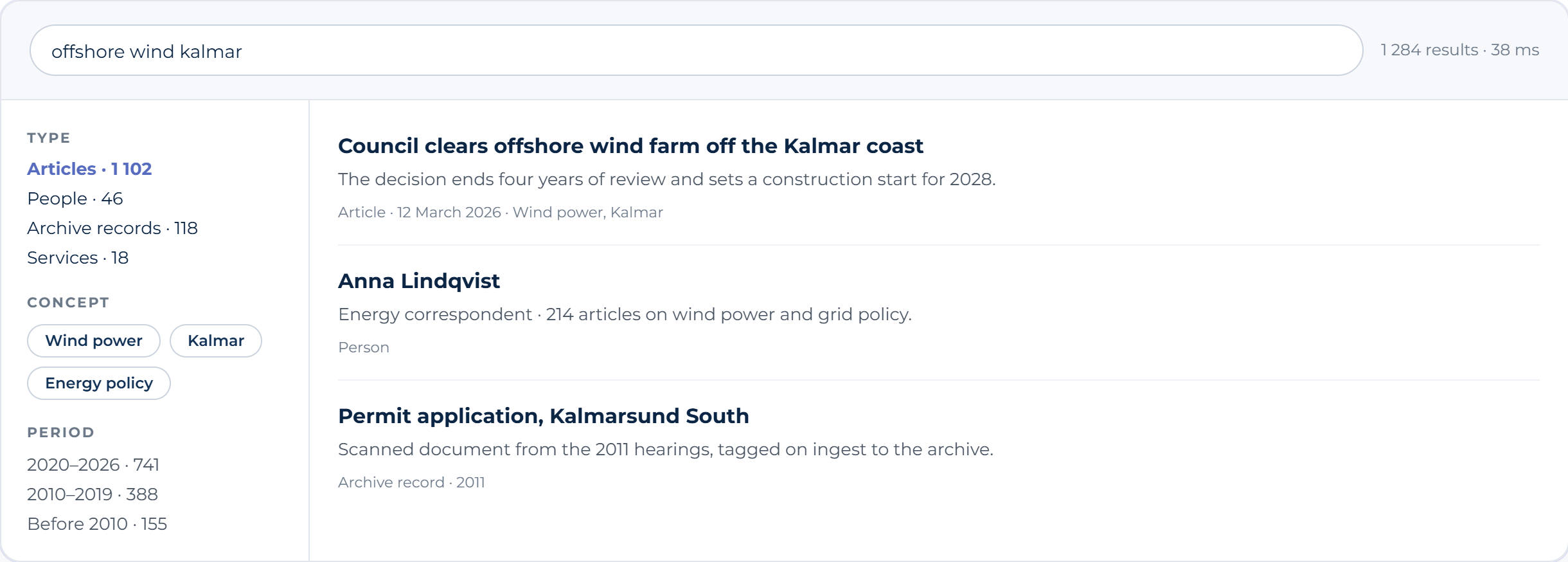
Free-text search finds words. Concept-aware search finds subjects, people, places and events across everything you hold, including the decades before anyone tagged anything.
Query understanding
Nobody searches the way your documents are written
People type acronyms, internal shorthand, half-remembered product names and the wrong language. A keyword index answers literally and returns nothing. Concept-aware search resolves what was meant before it looks anything up.
Because the expansion runs on your own vocabulary, it knows that DPA is a data processing agreement in your organisation and not something else entirely.
Acronyms and internal shorthand resolved to the real term
One query across every language you publish in, one ranked list back
Every expansion visible, so you can audit why a result ranked
dpa supplier nordics
3 typed terms → 41 matched concepts
Search as a demand signal
The searches that fail tell you what the archive is missing
Every query that returns nothing useful is someone telling you what they expected to find. Grouped by concept rather than by string, failed searches stop being noise and become a short list of fixable problems.
What they typedResultNearest conceptDiagnosisFix
battery plant permit0 hitsBattery plantsNothing in the archive covers this. Rising for four months running.Acquire or commission
dpa template danish3 weakDPA template v3The document exists in English only. The Danish version was never linked.Link translation
supplier code of conduct0 hitsProcurement policyTwo documents cover it but neither carries the concept, so neither is findable.Retro-tag
ölandsbronsplitÖland bridgeTwo spellings became two concepts, each holding half the records.Merge concepts
q3 board decision vendor41 hitsBoard minutesThe answer is there but buried. No facet exists for decision type.Add facet
The same report drives the Authority Profile in ConceptCore, so a discovery gap and a coverage gap are the same finding seen from two directions.
What the search layer has to get right
A search box is easy. A search layer that a whole organisation trusts to find things is a different problem.
Multi-type results
Documents, people, places, services and archive records in one ranked list, each with its own result layout instead of a single generic row.
Facets from your taxonomy
Filters generated from the vocabulary you already maintain, so they stay consistent as it grows rather than being hand-built per view.
Access-aware by design
Ranking runs over what the person is entitled to see. A restricted document never appears in a count, a facet or a suggestion.
Archive on equal terms
Retro-tagging brings decades of older material into the same index with the same concepts and the same filters as everything published today.
Retrieval an assistant can cite
The same endpoint that serves your search box serves your internal assistant, returning passages with concepts and provenance attached.
Cross language support
Ask in one language and get results from all of them. Concepts are language-independent, so the index does not fragment per market.
Curious what your archive is worth?
Bring a sample of your content and we will tag it live.